What “Website Maintenance” Should Actually Include
By Egor · · 9 min read
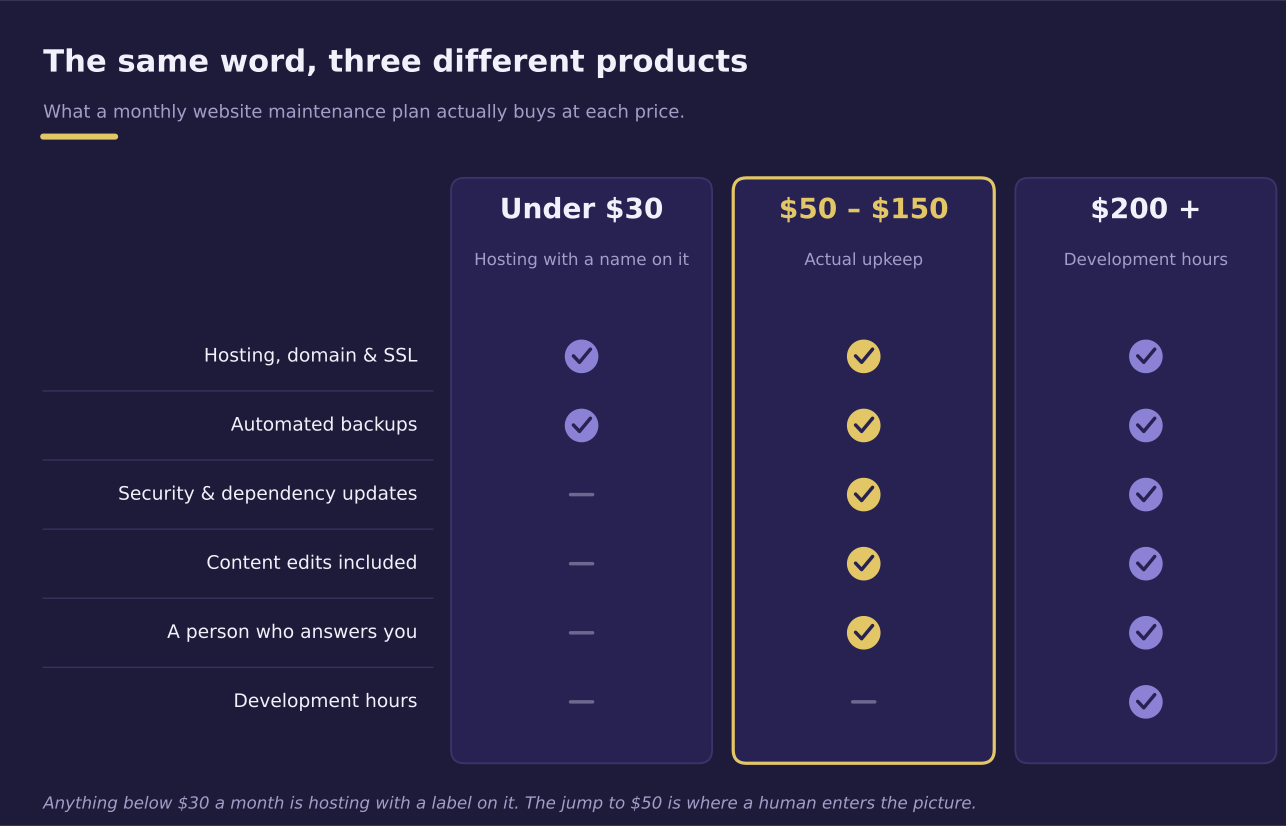
Short answer: at a minimum it should cover hosting, backups, security updates, content edits that are counted rather than vaguely promised, and a response time you can hold someone to. Anything sold as maintenance that includes none of those is hosting with a nicer label. Expect under $30 a month for that bare version, $50–$150 for genuine upkeep, and $200 and up when you’re really buying development hours.
Two providers quote you $99 a month for website maintenance. One is running automated backups and nothing else. The other will rewrite your homepage copy on request and fix a broken checkout on a Sunday. Same word, same price, completely different product.
That’s the whole problem with this category. “Maintenance” isn’t a defined service, it’s a label, and it gets stuck on everything from bare hosting to a part-time developer. Here’s how to tell which one you’re actually being offered.

What you’re paying for no matter what
Some costs exist whether or not anyone is maintaining anything:
- Hosting. A few dollars a month for a small site, more if you have real traffic.
- Your domain. $10–$20 a year.
- SSL. Free on most modern hosts, so don’t let anyone bill you separately for it.
That’s the floor, and it’s small. Any plan priced below about $30 a month is essentially this floor with a label on it. Nothing wrong with that as long as you know it’s what you’re buying, and as long as nobody’s describing it as support.
The three things sold as “maintenance”
Tier one: hosting with a name on it. Under roughly $30/month. Automated backups, an uptime checker, maybe a monthly email telling you everything is fine. No human looks at your site unless you pay extra, and “extra” is where these plans make their money.
Tier two: actual upkeep. Roughly $50–$150/month, which is where most small businesses land. Security and dependency updates, real backups on a schedule you can name, and a person who answers when you email. Crucially, this tier includes content edits: new hours, a new team member, a seasonal promo. That’s the difference between a plan and a subscription.
Tier three: ongoing development. $200/month and up. At this level you’re buying hours, not upkeep. New pages, functional changes, performance work. Published figures put freelance and agency rates in the $50–$150 per hour range for ad-hoc work, so it’s worth doing the division: a $300 plan that includes three hours is priced at $100/hour, which may be perfectly fair, but you should know that’s what you’re buying.
A note on where those numbers come from. Almost every published guide to maintenance pricing is written by a company that sells maintenance. The ranges above appear consistently across several of them, which is some evidence, though not the same as an independent survey. (WebFX maintenance pricing, checked August 2026.)
The questions that reveal what you’re buying
Ask these of any plan, including mine — they’re a natural follow-on to the questions worth asking before you hire anyone.
“How many content edits are included, and how are they measured?” A plan that includes edits will tell you a number, in items or in hours. A plan that dodges this is selling you hosting.
“What’s your response time?” Not “we’re responsive.” A number of business days. If it isn’t in writing, it isn’t a commitment.
“How often are backups taken, and how do I get one?” Quarterly backups are close to useless for a site that changes weekly. And a backup you can’t request is a backup you don’t have.
“What counts as a separate project?” Every honest plan has a line where upkeep ends and new work begins. You want to know where that line is before you cross it, not after.
“What happens if I stop paying?” This one matters more than the rest combined, and I’ve written about what you actually own separately. If the answer is that your site goes offline, you’re renting.
When you need no plan at all
I sell maintenance plans, so weigh this section accordingly. But the honest answer is that plenty of small businesses don’t need one, and the reason is technical.
A site built on WordPress genuinely rots. Plugins update, updates conflict, something breaks silently, and six months later your contact form has been swallowing messages. That kind of site needs somebody watching it.
A custom-coded static site is different. There are no plugins to conflict, no database to corrupt, no admin login to get compromised. It sits there and works. It still needs hosting and a domain renewal, but “maintenance” in the WordPress sense mostly doesn’t apply.
So skip the plan if:
- Your site is a handful of pages with no database or booking system behind it
- Your content changes once or twice a year
- You’re comfortable logging into a hosting dashboard when you need to
- Money is tight and the site isn’t your main source of leads
One middle option worth knowing about, because it isn’t really maintenance. My Lite tier exists mostly so the running costs arrive as a single predictable payment instead of several separate bills. Hosting, the domain renewal, SSL, and the small recurring services your site depends on (a mailbox subscription, for instance) are paid inside the $50 rather than landing on your card at scattered points in the year. There’s a ceiling on that, agreed with you at the start rather than discovered later. If your site outgrows it, you move up a tier instead of getting a surprise invoice. Break-fix and one small edit a month come with it too. If your reason for wanting a plan is “I don’t want to think about any of this,” that’s the tier, and it isn’t because your site needs looking after. The plans are here.
Take a plan if:
- Your site takes bookings, payments, or orders, because those have moving parts that fail
- You change content monthly and don’t want to do it yourself
- Downtime costs you money the same day it happens
- You’d rather pay a known amount than deal with it
What I charge
Four tiers. The first is close to bare cost, the last is a part-time developer.
| Plan | Price | What it’s for |
|---|---|---|
| Lite | $50/mo | Keep the lights on. Hosting, domain, SSL, uptime monitoring, break-fix for things you didn’t cause, one edit a month, quarterly backups. Response in 3–4 business days. |
| Care | $100/mo | Everything in Lite, plus real upkeep: security and dependency updates, monthly backups, three edits a month up to two hours, and a brief monthly check-in. Response in 2–3 business days. |
| Growth | $200/mo | Everything in Care, plus the site keeps improving: five edits up to five hours, small functional tweaks, speed tuning, weekly backups, and a monthly report with actual speed and traffic numbers. Response in 1–2 business days. |
| Partner | $500/mo | Everything in Growth, plus up to ten hours a month, new sections and pages within those hours, a staging environment so updates get tested before they go live, daily backups, and the widest allowance for backend service costs. Priority response, same or next business day, and a short monthly strategy call. |
Do the division on mine too. Care is $100 for two hours, Growth $200 for five, Partner $500 for ten. That works out to $40–$50 an hour depending on the tier, against the $50–$150 the market charges for ad-hoc work. Anything past the included hours is billed at $40/hour, whichever plan you’re on, and that rate is on the plans page rather than buried in a clause you find later. Paying annually lowers the monthly price as well: Care goes from $100 to $85, for example.
On the running costs. Every tier covers the recurring bills your site depends on (hosting, domain, and the paid services attached to it) up to a ceiling we agree on before you start. Higher tiers carry a bigger allowance. Nobody gets a surprise invoice; if usage outgrows the tier, you move up a tier.
Where the line is. Big work is a separate project, quoted on its own: a redesign, a major new feature, a store section that didn’t exist before. I’d rather tell you that upfront than quietly stretch a $100 plan across forty hours of work and do all of it badly.
You can also take none of these. You get every login, the code, and instructions. Plenty of clients run their own site and come back to a plan later if things get busy.
What happens if you stop paying
This is the part of the industry I’d most like to see change, so here’s my version in full.
There’s no minimum term. If a payment is missed, you get a warning, then a second one over the following week. If it’s still unpaid after that, the plan cancels. That’s the whole process.
When it cancels, you get every login, the hosting passwords for anything I had access to, and basic instructions for keeping the site running. The code was already yours from the day the site launched. Nothing goes offline, nothing gets held, and you don’t have to ask for any of it. That’s the opposite of the far more common story, where the person who built your site simply stops answering — if that’s where you are, here’s how to get it back.
One thing to know: if you prepay for a year and cancel in month three, the plan runs to the end of the year but the money isn’t refunded. I’d rather say that plainly here than have it be a surprise later.
The full pricing breakdown across build and support is here, if you want to see how this fits with the rest.
Is a monthly website fee normal?
Yes, and also often unnecessary. Hosting and your domain cost money regardless, and that’s a small, unavoidable amount. Everything above that is a service, and whether it’s worth it depends on how much your site changes and how much it costs you when it breaks.
How much should website maintenance cost per month?
Under $30 is hosting. $50–$150 is where real upkeep sits for most small businesses. Above $200 you’re buying development hours, and you should be able to name how many.
What does website maintenance include?
At minimum: hosting, backups, security updates, and someone who responds when something breaks. Content edits should be included and counted. Anything described as maintenance that includes none of these is hosting with a different label.
Do I need a maintenance plan for a simple website?
Often not. A static site with no database or plugins doesn’t decay the way a WordPress site does. If your site is a few pages, changes rarely, and you’re willing to handle a domain renewal once a year, you can run it yourself.
Can I cancel a maintenance plan?
You should be able to, at any time, and keep your site. If a plan can’t be cancelled without your website going offline, that’s not maintenance, that’s a rental agreement. Ask before you sign, and ask what else got left unfinished while you’re at it.
The checklists, in one PDF. All four one-pagers from this series — is the quote fair, the ten-minute site check, what you actually own, and nine questions before you hire. Open the PDF →
Written by Egor, founder and developer at AmetEdge. I build custom websites for small businesses across the US: restaurants and cafés, auto repair and body shops, contractors and home services, dental and medical clinics, salons and studios, gyms and trainers, and plenty of others. No agency, no upfront payment, and you own everything at the end.