How Much Does a Small Business Website Cost in 2026?
By Egor · · 9 min read
Short answer: most small businesses in the US pay between $1,000 and $8,000 for a professional website, plus $20 to $200 a month to keep it running. Build it yourself on Wix or Squarespace and you’ll spend closer to $200–$600 a year, paid for with your own evenings.
That’s a wide range, and it comes down to two things: who does the work, and how much work there is. Below I’ll walk through all four routes with real numbers, show you the costs that rarely make it into a quote, and tell you what I charge and why.
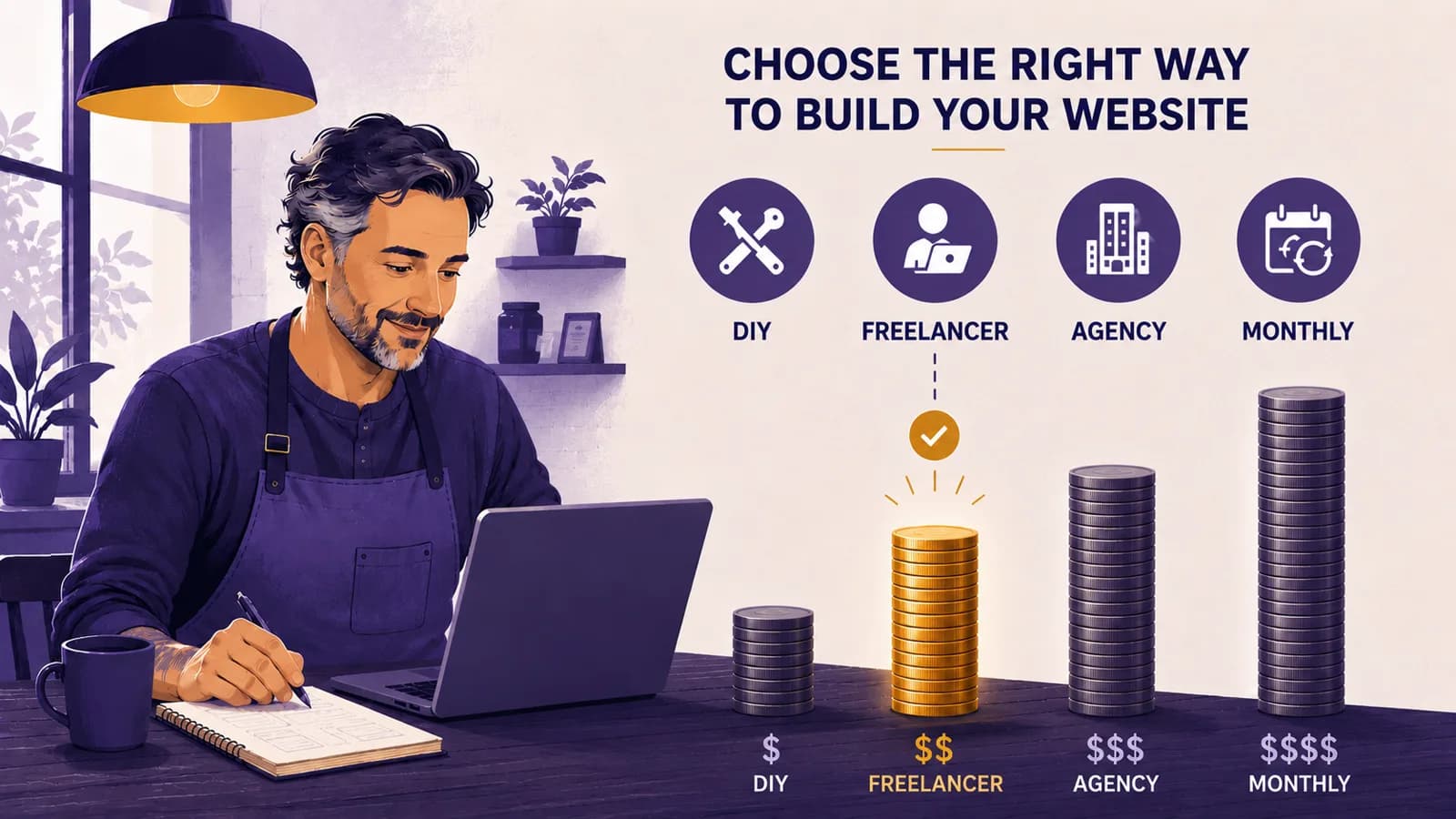
The four ways to get a website
| Route | Typical cost | How long | Best for |
|---|---|---|---|
| DIY builder (Wix, Squarespace) | $17–$49/month, forever | A weekend to a few weeks of your time | Testing an idea before you commit |
| Freelance developer | $1,000–$8,000 one-time | 1–6 weeks | Most small service businesses |
| Agency | $5,000–$30,000+ | 1–3 months | Large catalogs, multiple locations, full brand systems |
| Monthly “website subscription” | $225–$499/month, forever | 2–4 weeks | Zero upfront cost, if you read the contract carefully |
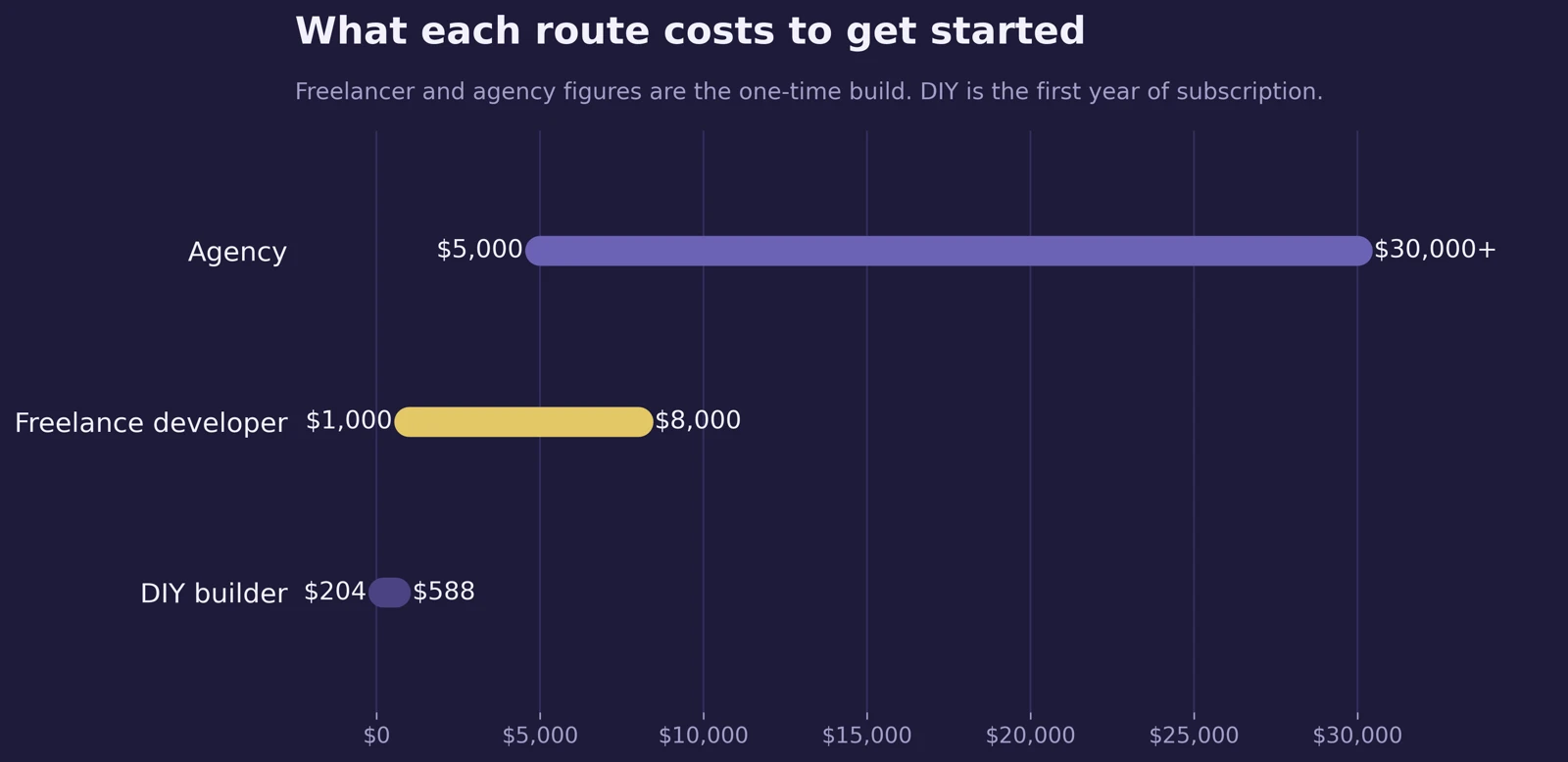
Website design prices published across 2026 keep landing in the same band for professional small business sites: roughly $2,000 to $8,000, with more involved builds running past $15,000. If a quote comes in at $400 or at $40,000, it’s fair to ask what makes it different.
One thing worth saying plainly. I couldn’t find a single credible industry survey behind most of the precise-looking statistics floating around this topic. A lot of pricing articles cite each other in a loop. The ranges above are what multiple independent guides agree on, not a number I can point to a study for.
What you’re actually paying for
A website quote is usually five or six things bundled into one figure. Knowing the parts makes two very different quotes comparable.
Design. How the site looks. A template costs almost nothing. Custom design, where someone draws your site from a blank page instead of adapting a theme, is the single biggest swing factor in any quote. It’s also the main reason an agency figure and a freelancer figure can differ by 5x for the same page count.
Development. Turning the design into a working site. A brochure site is quick. Booking systems, customer accounts, and online payments are not.
Content. Words and photos. This one blindsides people. Professional copywriting runs $50–$150 an hour, and a proper photo shoot for original images runs several hundred to a few thousand. Plenty of projects sit half-finished for months because nobody wrote the About page.
Setup. Domain, hosting, SSL, email. A domain runs about $10–$20 a year and hosting for a small site is a few dollars a month. Small money, but someone has to configure it properly.
Search groundwork. The technical basics that let Google read and index your site: clean URLs, page titles, a sitemap, mobile rendering, reasonable load speed. This is a different job from SEO as an ongoing service, with a different budget. Ask any quote which one it includes, and if the answer is vague, that’s your answer. I’ve written up how I handle the split on the FAQ page.
cost
Route 1: Building it yourself
Most owners start here, and sometimes that’s the right call.
Wix runs $17 to $159 a month: $17 for Light, $29 for Core, $39 for Business, and $159 for Business Elite. Squarespace starts at $19 a month for Basic and tops out at $99 for Advanced. Both of those are the annual-billing numbers, and that’s the part worth noticing. Wix states plainly that displayed prices are for yearly subscriptions paid in full at purchase, so the advertised figure assumes you’re handing over a year in advance. Squarespace does show month-to-month pricing, and it’s about 25% higher: Basic goes from $19 to $25, Core from $29 to $39, Advanced from $99 to $139. (Wix pricing, Squarespace pricing, both checked August 10, 2026.)
Call it $200–$600 a year. Hard to argue with that.
The subscription isn’t the whole price, though:
- Your free first-year domain renews at around $20/year
- Plugins and add-ons stack up: scheduling tools start around $16/month, email marketing from a few dollars to $50+
- On Squarespace’s entry Basic plan, selling costs you 2% of every physical product sale and 7% on digital products or memberships, on top of card processing. Higher tiers drop the store fee to zero (Squarespace fees, checked August 10, 2026)
- And the real one: your time. A DIY site is a few days of work if you know what you’re doing, and a few weeks of evenings if you don’t
Two things surprise people later. The first is that you never stop paying. Cancel the subscription and the site comes down, so year five costs the same as year one. The second is that templates are shared. The same theme that looks great on your site is running on a few thousand others, sometimes including the competitor two blocks away, and customers who visit both notice.
The bigger risk isn’t the monthly fee, though — it’s that a DIY site rarely gets finished. I audited three cheap small business sites, and the common thread wasn’t slow loading, it was the details nobody went back to complete.
Build it yourself if: you’re testing whether the business works at all, and “good enough” is good enough for now.
Don’t if: the site needs to bring in work while you’re busy doing the work.
Route 2: Hiring a freelance developer
Expect $1,000–$8,000, delivered in one to six weeks. What web designers charge inside that range depends on three things: whether the design is custom or adapted from a theme, how much the site has to do beyond displaying information, and who writes the words. The low end is a small site on a solid template. The high end is fully custom design with real functionality behind it.
What you’re buying at this tier is one person who is accountable to you. No account manager, no ticket queue, no project quietly handed to a junior in week six. You describe your business to the person who is actually going to build it, and when you want the booking button moved, you text one number and it moves.
That direct line changes the result more than most owners expect. A freelancer sees your first draft, hears what bothers you about it, and adjusts the same week. Usually two or three rounds of that before launch. Agencies bill for revision rounds because every change has to travel through a project manager. Builders don’t offer the option at all: the template is the template.
The other difference is what you end up with. A freelancer who codes rather than assembling themes can build the thing your business actually needs: a menu you update yourself, a quote form that asks your questions, a booking flow that matches how you really take appointments. Whether a given freelancer works that way is a fair thing to ask before hiring, and the answer is easy to verify. Ask to see two sites they’ve built and check whether they look like the same site twice.
The honest risk: it’s one person. If they vanish, there’s no bench behind them. That’s a real concern, and it’s the reason the five questions at the end of this article exist. A freelancer who answers all five in writing, and hands you every login at launch, is one you can leave whenever you like. The risk isn’t hiring one person. It’s hiring one person who keeps the keys.
For what it’s worth: I hand over the code, the domain, and every login at launch, so if I disappear, the site stays online, stays yours, and what happens next is your call. If a past developer already did the opposite, here’s how to recover a site you’ve lost access to.
Hire a freelancer if: you run a service business (a restaurant, a repair shop, a contracting company, a clinic) and you want a site that doesn’t look like three competitors’ sites.
Route 3: Hiring an agency
Agency builds start around $5,000 and climb past $30,000, usually across one to three months. You get a team: designer, developer, project manager, often a copywriter and an SEO specialist.
For a five-page site, that’s more machinery than the job needs. You’re paying for coordination the project doesn’t generate, and you feel it in the process. The person who pitched you is rarely the person who builds it. Revision rounds are capped and billed. A change that takes twenty minutes of actual work takes a week to move through the queue.
Agencies earn their price on genuinely complex work. Large product catalogs, multiple locations, integrations with software you already run.
Hire an agency if: the project is complex, or work needs to continue regardless of whether any one person is available.
Route 4: The monthly “website subscription”
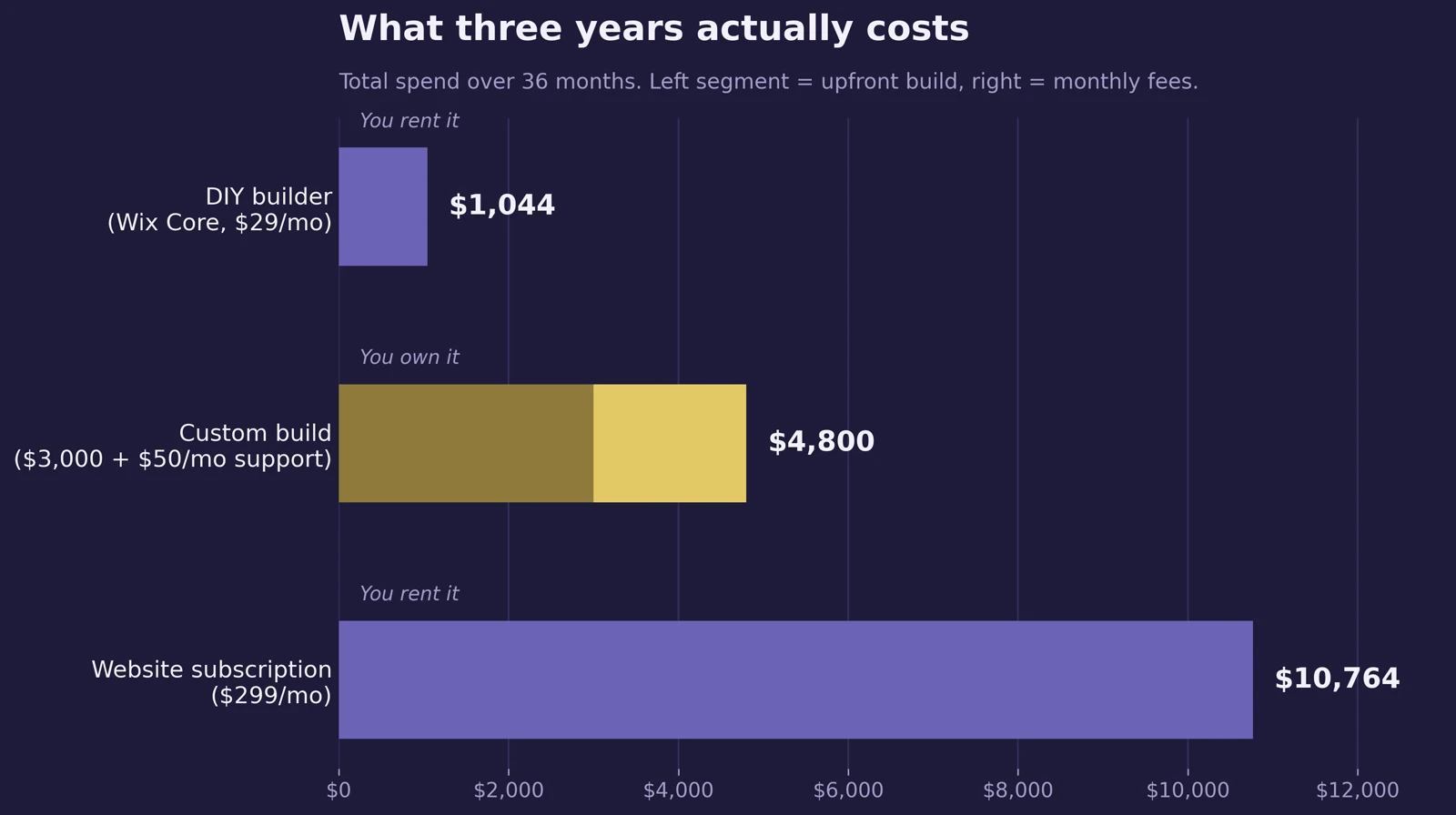
You’ve seen the ads: no upfront cost, $299 a month, we handle everything. These typically run $225–$499/month.
The math deserves a second look. At $299/month, three years costs $10,764, more than most custom builds. And in many of these arrangements you don’t own the site. Stop paying, it goes offline.
There’s a second catch beyond the money. These providers keep costs down by building everyone the same site from the same small set of layouts, so you’re paying custom-build prices over three years for a template you don’t own. The arrangement is also designed to be hard to leave: the longer you stay, the more content lives inside a system you can’t export.
I’m not saying never. If cash flow is the binding constraint, a subscription can make sense. But get two answers in writing before you sign:
- If I cancel, does my website stay online?
- If I cancel, do I keep the domain?
If either answer is no, you’re renting rather than buying. That’s a legitimate choice, as long as you’re making it knowingly.
The costs that don’t show up in the quote
This is where budgets break. For a custom site, plan on $50–$200 a month after launch. On a DIY builder it’s lower, usually $0–$50 beyond the subscription itself. It’s worth knowing what that monthly fee should actually cover before you agree to one.
That covers:
- Hosting, domain renewal, SSL. Unavoidable running costs
- Updates and fixes. Things break, browsers change, contact forms stop delivering and nobody notices for a month
- Content changes. New hours, new menu, new team member, seasonal promotion
- Backups. You’ll need one eventually, and that day is the wrong day to discover you don’t have any
Add it up before you compare quotes. A cheaper build with expensive monthly fees can cost more over three years than a pricier build with none.
What I charge, and why
This article would be a little hypocritical without this section.
| Package | Price | What it’s for |
|---|---|---|
| Basic | ≈ $900–$1,500 | A clean, custom site that makes you look professional |
| Pro | ≈ $2,000–$4,000 | Bookings, quote requests, scheduling. The site does actual work |
| Enterprise | ≈ $5,000–$8,000 | Full online store: catalog, cart, checkout, customer accounts |
| Individual | Custom quote | When none of the above fits |
Why Basic starts below the ranges above. An agency quoting $5,000 for a similar site isn’t overcharging. They’re covering a designer, a developer, a project manager, and an office. I’m one person with none of that overhead, and I’ve built the tooling to move quickly. The work is the same; the cost structure isn’t. What I can’t offer at that price is a team that keeps going if I’m unavailable, which is exactly the trade-off you’re making at this tier.
Support afterward is optional, from around $50/month for hosting and monitoring up to $500/month for revenue-critical sites with priority response. You can also take none of it: you get every login, and the site is yours to run.
Two things that differ from most quotes you’ll receive:
You pay nothing upfront. I build the site first. You see the finished thing, we adjust it, and you pay only when you’re happy. If you’re not, you walk away owing nothing.
You own it. Domain, hosting, code, all yours, whether or not you ever pay me again. That’s how it should work. (Not sure who owns yours right now? Here’s how to check.)
How to tell if a quote is fair
Five questions. Ask them of me too — and if you’re weighing up the people behind the quotes, here are nine questions to ask before you hire.
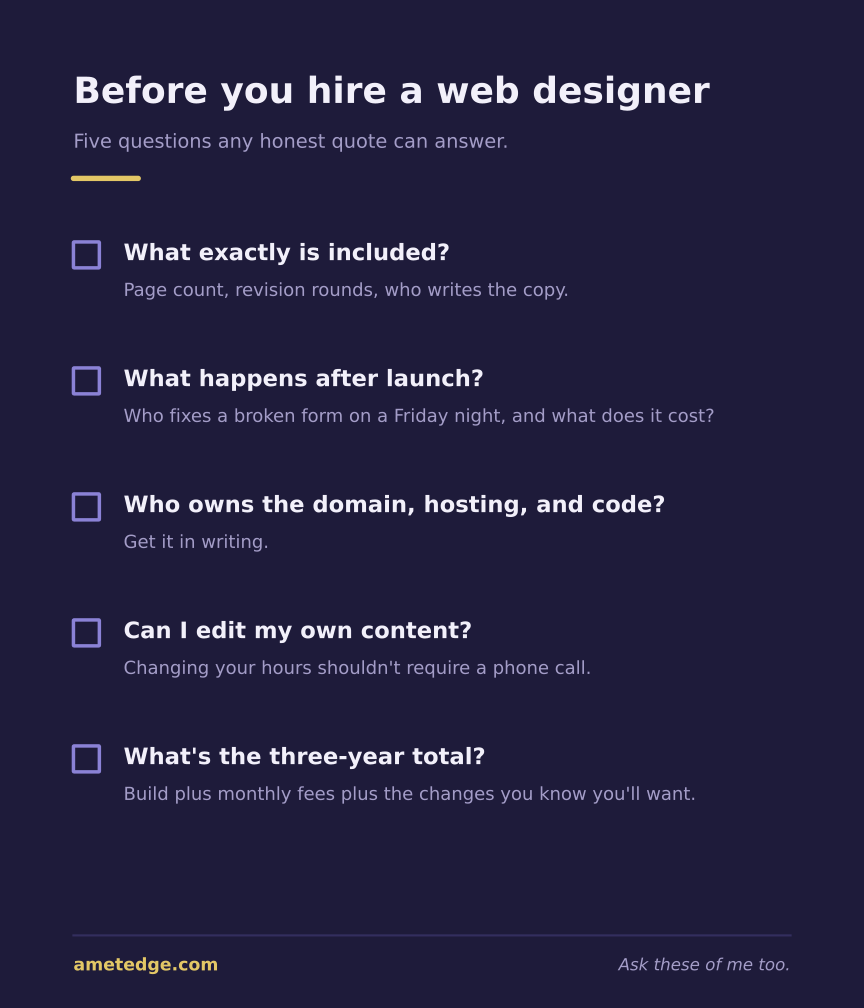
A quote that can’t answer these isn’t cheap. It’s incomplete.
Common questions
Is it expensive to build a website for a small business?
Not compared to what it replaces. A $2,000 site is less than many businesses spend on a single month of paid ads, and it keeps working after the ad budget stops. Expensive is paying $299 a month for three years and owning nothing at the end. If you want a realistic number for your specific situation, the 2-minute quiz gets you one without a phone call.
Is $500 too cheap for a website?
Usually. At that price you’re getting a template with your logo dropped in, or the first month of something much more expensive. Either can be fine. You just want to know which one you’re signing up for before you pay.
How much do web designers charge per hour?
Hourly rates in the US typically fall between $50 and $150, though most small business projects are quoted as a fixed price rather than hourly. Fixed pricing is usually better for you: the risk of the project taking longer than expected sits with the developer instead of with your budget.
How long does a small business website take?
One to six weeks with a freelancer, one to three months with an agency. The slowest part is almost always waiting on content from the business owner.
Do I need to pay monthly?
No. Hosting and your domain cost money regardless, and that’s small. Everything beyond that is a choice about whether you’d rather manage the site yourself or hand it off.
Is a more expensive site better?
Not automatically. Price reflects how much custom work went in, which is a different question from whether the site turns visitors into customers. A $2,000 site with a clear message will out-earn an $18,000 site that buries the phone number.
The checklists, in one PDF. All four one-pagers from this series — is the quote fair, the ten-minute site check, what you actually own, and nine questions before you hire. Open the PDF →
Written by Egor, founder and developer at AmetEdge. I build custom websites for small businesses across the US: restaurants and cafés, auto repair and body shops, contractors and home services, dental and medical clinics, salons and studios, gyms and trainers, and plenty of others. No agency, no upfront payment, and you own everything at the end.