9 Questions to Ask Before You Hire a Web Designer
By Egor · · 10 min read
You have two quotes in front of you and no way to tell which person will actually deliver. Both sound confident. Both have a nice-looking site of their own. The prices aren’t far apart.
Nine questions will separate them faster than anything else, and the useful part isn’t the questions. It’s knowing what a straight answer sounds like against an evasive one. So for each question below, I’ve written both.
Ask these of me too. My own answers are at the end, including the ones that are less comfortable for a one-person operation.

1. Can you show me two sites you’ve built?
This is the only question whose answer you can verify without trusting anyone. Open both sites on your phone and look.
A straight answer is two live links. Then check the thing that matters: do they look like the same site twice? If both have the same layout with different photos, you’re hiring someone who fills in templates. Nothing wrong with that at the right price, but you should know it’s what you’re buying.
An evasive answer is screenshots instead of links, or “I can’t share client work,” which is unusual for websites since they’re public by definition.
A third possibility: someone genuinely new who says so plainly and offers something else instead. That’s not a red flag on its own. What matters is whether they’re upfront about it and what they offer to reduce your risk.
2. Who will actually do the work?
A straight answer names a person. If it’s an agency, you learn who designs, who builds, and who you talk to when something’s wrong.
An evasive answer is “our team will take care of it.” At agencies, the person who pitched you is often not the person who builds it, and the handoff is where detail gets lost. With a freelancer, this question occasionally uncovers that your project is being resold to someone else entirely.
3. What exactly is included?
A straight answer has numbers in it: how many pages, how many rounds of revisions, who writes the copy, whether the technical basics that let Google read your site are in scope or extra.
An evasive answer is “a full professional website,” which describes both a $500 template and a $15,000 build. If a quote can’t be broken into parts, it can’t be compared to another quote. I’ve written more about what goes into the price if you want the breakdown.
4. What do you need from me, and by when?
The most useful question on this list, and almost nobody asks it.
Projects rarely stall because the developer is slow. They stall because nobody wrote the About page, or the photos never arrived, or the owner couldn’t decide on a tagline. Two weeks of work stretches into three months, and both sides get frustrated.
A straight answer is a list with dates: copy for these pages, photos of this kind, your logo file, your hours, your service list, by roughly this point.
An evasive answer is “just send whatever you have.” That means you’ll be improvising content at the exact moment you’re busiest.
5. What happens when I don’t like the first version?
You won’t love it the first time. That’s normal and it’s part of the process.
A straight answer explains the process: how many rounds are included, what counts as a revision versus a new request, and what happens after that. Some charge for extra rounds, which is fair as long as you know the number.
An evasive answer is “everyone loves it” or a vague reassurance. Watch how they react to the question itself, because that’s a small preview of how they’ll react when you actually disagree with them.
6. Who owns the domain, the hosting, and the code?
Get this one in writing, whatever the answer.
A straight answer is that the domain is registered in your name, you have hosting access, and the code is yours. Ideally on paper.
An evasive answer is “we handle all that for you,” which may be a genuine convenience and may mean your business address belongs to someone else. There’s a real difference, and it’s worth understanding before you sign, not after.
7. Will I be able to change content myself?
Your hours change. A staff member leaves. You run a promotion.
A straight answer tells you which things you can edit and which need them. Both lists are fine, as long as you know what’s on each.
An evasive answer is “just email us any time.” That sounds generous and often means every trivial change goes into a queue behind other clients. If updating your hours requires someone else’s calendar, you’ll stop updating your hours.
8. What happens after launch, and what does it cost?
A straight answer is either a named plan with a price and a response time, or a clear “nothing from me, and here’s what you’ll be paying directly.” Both are legitimate, and the second one should still come with numbers, because “free” isn’t accurate. Your domain renews every year, hosting costs something every month, and any paid service wired into your site keeps billing whether or not anyone is maintaining it. Someone who tells you that upfront is telling you the truth about your actual costs. Someone who lets you believe the site is free after launch will be having an awkward conversation with you in eleven months.
An evasive answer is “we’ll figure it out later.” That’s how a $1,200 project turns into an open-ended monthly bill nobody agreed to. Ask what’s included, how edits are counted, what you’ll be billed for directly, and what happens if you stop paying. I’ve written up what a maintenance plan should actually include, including when you need none at all.
9. What if you’re unavailable partway through?
Illness, family emergencies, a bigger client. It happens, and the answer tells you a lot.
A straight answer is concrete: a partner who can step in, a documented handover process, staged payments so you’re never far ahead of the work, or an arrangement where you simply haven’t paid yet.
An evasive answer is “that won’t happen.” It might. The question isn’t whether someone can promise perfect availability, it’s whether they’ve thought about what you’d be left holding. If a previous developer has already gone quiet on you, here’s how to get your site back.
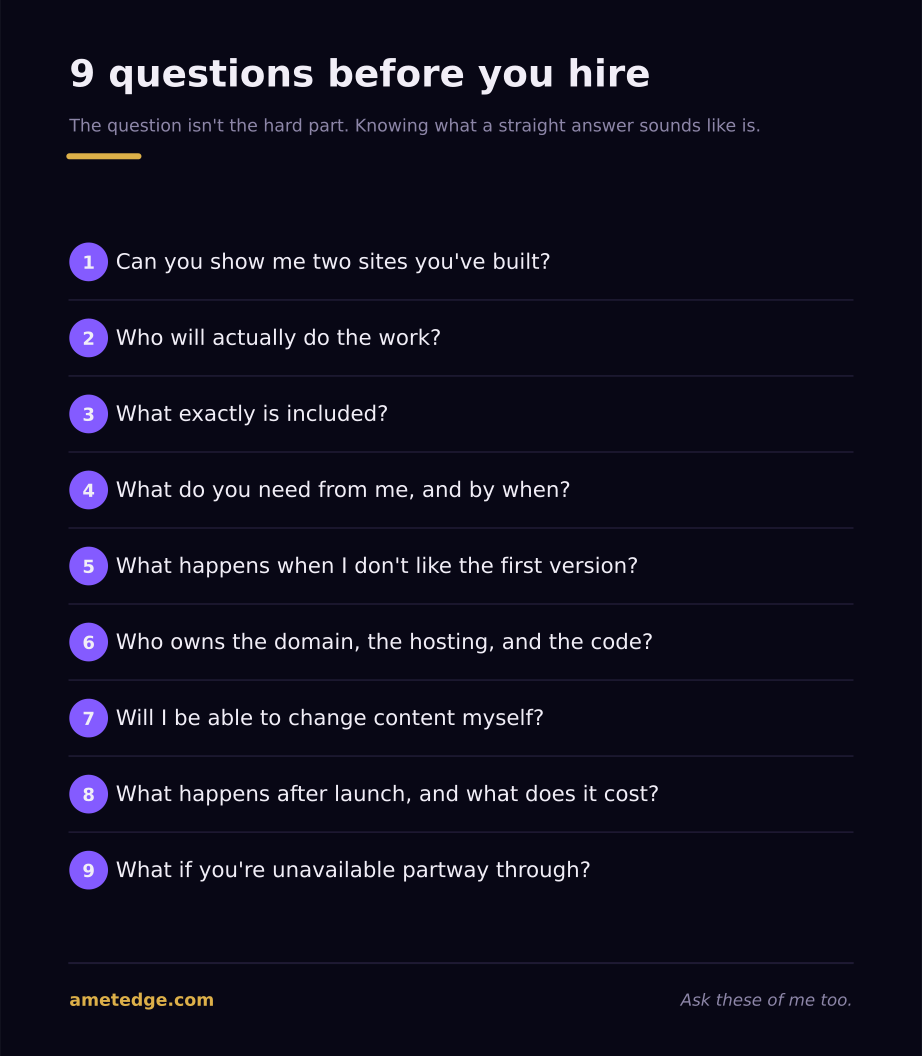
How I’d answer these
Short version, in order, including the one that goes badly for me.
1. Two sites? Yes, I’ll send you two examples to compare. I’d also suggest something more useful than looking at work I did for someone else: let me build your demo. You see your own site, in your business’s shape, and we adjust the direction and the style from there. Judging a finished thing you can click through beats judging a stranger’s project, and you pay nothing until you approve it.
2. Who does the work? Me. There’s nobody else.
3. What’s included? Listed per package, with page counts and what’s in scope, here. Technical SEO is included in every tier.
4. What I need from you? Your services or menu, hours, any photos you have, and a sense of what you want the site to do. I’ll tell you what’s missing rather than wait.
5. First version? We iterate until you’re happy, because you haven’t paid yet. That’s the whole model, and it’s also the honest reason I’d rather get it right on the second attempt than the fifth.
6. Ownership? The domain is registered in your name, always. The code is yours from launch. Nothing is held.
7. Editing content? Depends on the build. I’ll tell you upfront which parts you control.
8. After launch? Plans from $50 to $500 a month, with response times in writing. Or take none, in which case the running costs stay with you and go straight to the providers: the domain each year, hosting, and whatever paid services your site is connected to. A plan doesn’t make those disappear, it just rolls them into one bill along with the work.
9. If I’m unavailable? I’d do everything I could to hand the project to developer friends who work independently of me. If that fell through, the most you’d lose is the time invested: you’ve paid nothing upfront, the domain is already in your name, and the code is yours at launch.
Two things that aren’t questions
Watch how they answer, not just what they say. Someone who gets defensive at question 5 or 9 is showing you how they’ll handle a disagreement in week three. Someone who says “I don’t know, let me check” is showing you something better.
Get the important answers in writing. Not a formal contract necessarily. An email that says what’s included, who owns what, and what happens after launch is enough, and it takes them five minutes. Reluctance to put a straight answer in writing is itself an answer.
How do I know if a web designer is legit?
Ask for two live sites and open them yourself. Then ask who owns the domain and get the answer in writing. Those two steps filter out most of what you’re worried about.
Should I hire someone with no portfolio?
You can, if they’re upfront about it and structure the deal so your risk is small: payment on approval, staged payments, or a paid trial page. What should worry you isn’t inexperience, it’s inexperience that’s being hidden.
What should a web design contract include?
Scope with numbers, revision rounds, timeline with what’s needed from you, ownership of domain and code, what happens after launch, and what happens if either side walks away. An email covering these is better than a long document covering none of them.
Is a cheaper designer worse?
Not automatically, though price does track how much custom work is involved. The bigger risk at the low end is a site that gets launched and never finished, which is a pattern I found on every budget site I looked at.
How many designers should I get quotes from, and how do I choose between them?
Two or three quotes is plenty. More than that and you’ll spend longer choosing than the build would take, and the quotes start blurring together anyway. To choose between them, put the answers side by side rather than the prices: the nine questions above will separate two similar-looking quotes faster than the numbers on them will.
The checklists, in one PDF. All four one-pagers from this series — is the quote fair, the ten-minute site check, what you actually own, and nine questions before you hire. Open the PDF →
Written by Egor, founder and developer at AmetEdge. I build custom websites for small businesses across the US: restaurants and cafés, auto repair and body shops, contractors and home services, dental and medical clinics, salons and studios, gyms and trainers, and plenty of others. No agency, no upfront payment, and you own everything at the end.