Google Business Profile: The Free Setup Most Get Wrong
By Egor · · 10 min read
Short answer: your listing already exists whether or not you made it, and if you haven’t claimed it, you don’t control what it says about you. Claiming is free, takes about twenty minutes, and matters more than most of what people spend money on.
I searched for tire shops in one American city and looked at the profile in first place and the one in 102nd. Neither of them has a website. Everything separating them lives inside the free listing.

The listing exists without you
This is the part that surprises people, so it’s worth saying plainly: Google creates business listings on its own, from street imagery, from other directories, from what customers submit. You don’t opt in. (The product is called Google Business Profile now; you may still know it as Google My Business, which is what it was until 2021.)
Here’s Rubios Tire Shop in Montgomery, Alabama. Perfect five-star rating across four reviews. And in the middle of the listing, a line reading “Claim this business.”
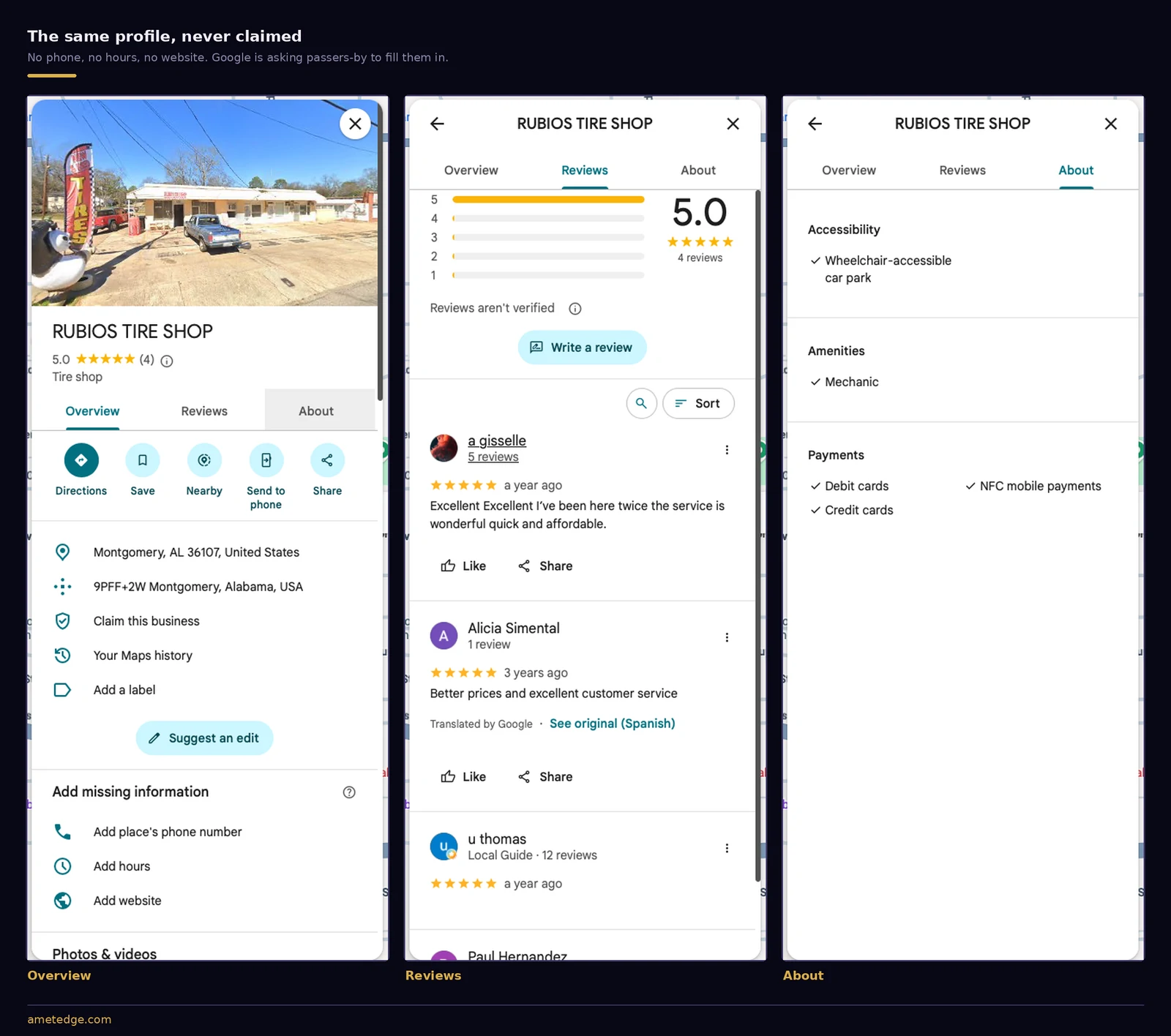
No phone number. No opening hours. No website. No street address, just the city, the postcode, and a Plus Code, which is what Google falls back on when nobody has given it a real address. The only photograph is a drive-by shot from Street View, taken by a car that happened to pass. Underneath, Google invites anyone at all to fill in the gaps: add place’s phone number, add hours, add website.
Four reviews, the most recent a year old, and not one owner response, because there is no owner attached to this listing.
This business is not missing from Google. It’s present, badly, and in someone else’s hands.
For the search “tire shop Montgomery AL,” it comes back 102nd.
What first place looks like
Same search, same city, same trade.
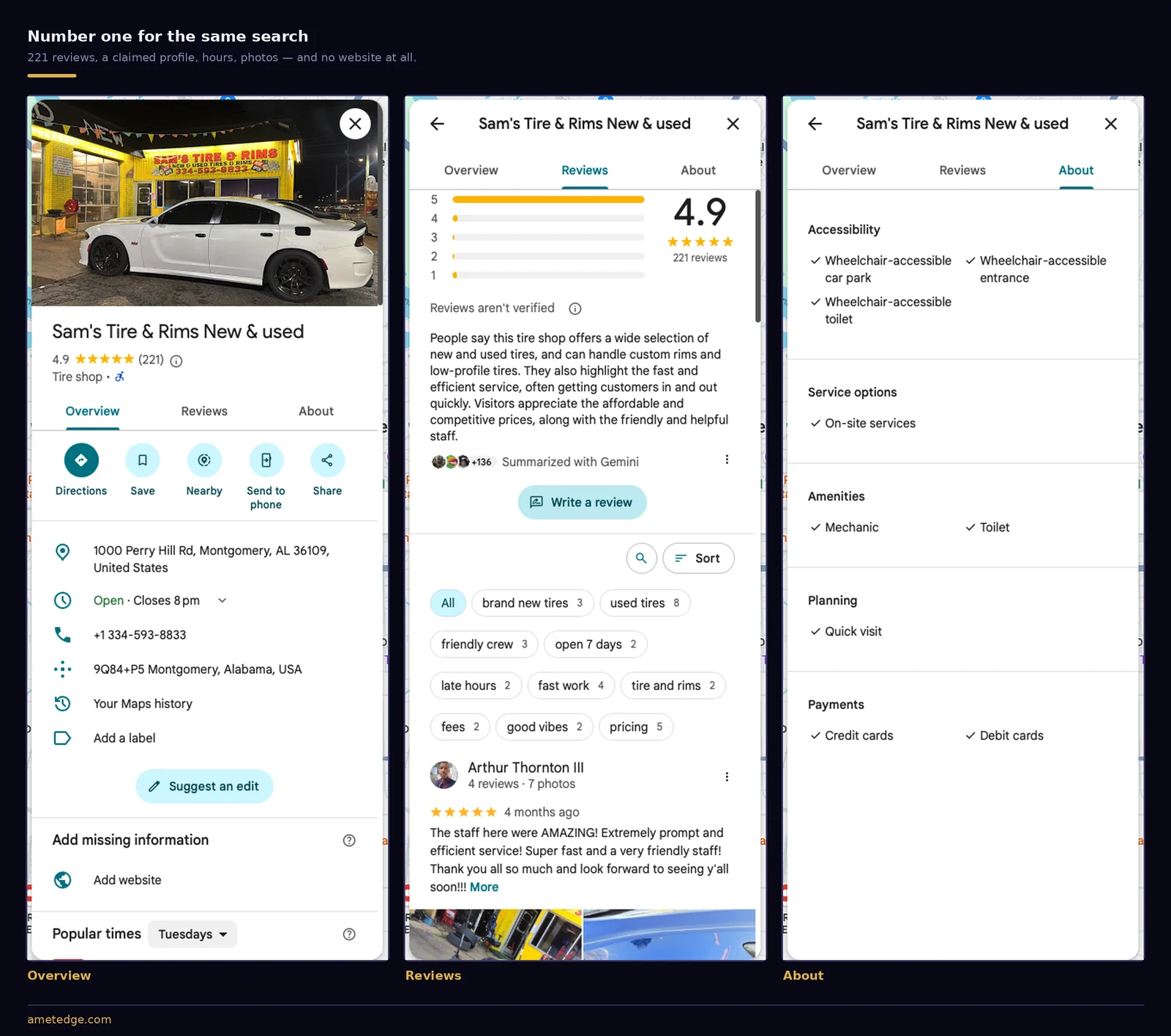
Sam’s Tire & Rims: 221 reviews, a street address, a phone number, opening hours that say it’s open now and closes at eight. A photograph of the shop at night, taken by someone who works there, with a customer’s car out front. Google has summarised the reviews and pulled out the themes people mention: used tires, late hours, fast work, pricing. There’s a chart of when the place is busy.
Two things about this comparison are worth sitting with.
The higher-rated business is the one in 102nd place. Rubios has 5.0 stars across four reviews; Sam’s has 4.9 across 221. Rating is not what decides this. Volume of reviews, completeness, and being claimed at all matter far more than the number under the stars.
Neither of them has a website. Sam’s profile still shows “add website” as missing information. The top result for a commercial search in a city of 200,000 people has no site at all, and it got there entirely on a free listing.
I build websites for a living, so that’s an awkward sentence to write. It’s also true, and the interesting question is what it means, which I’ll come back to at the end.
The failure that costs more than an empty listing
An empty profile doesn’t bring you customers. A wrong one sends them away angry, and that’s worse.
Here’s a dental practice in the same city. Unlike the tire shop, this listing is well populated: street address, phone number, website, 48 reviews at 4.8 stars. Google has filled it in from other sources.
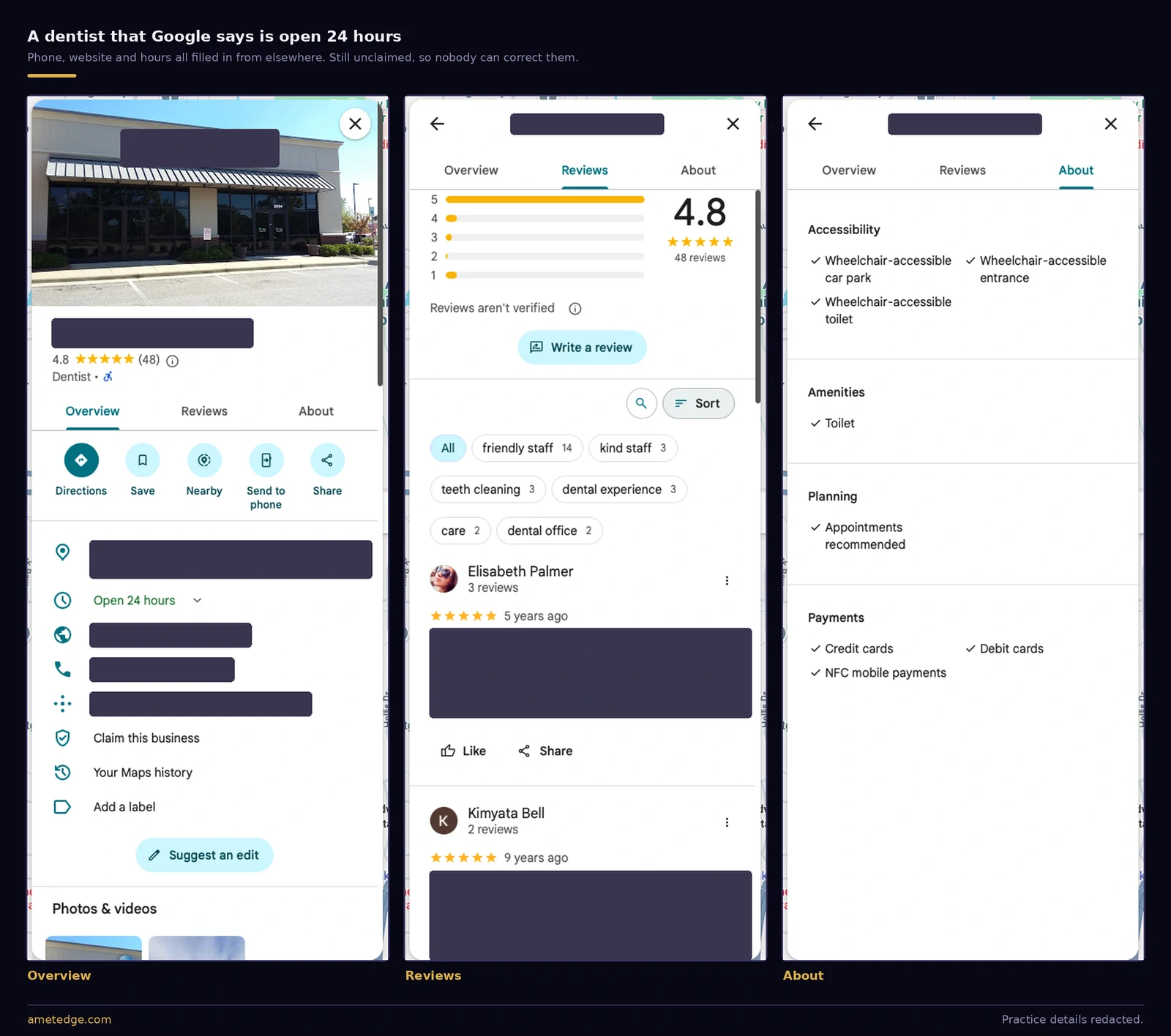
Under the hours it says “Open 24 hours.”
It’s a dental practice. It is not open 24 hours. Somebody with a toothache at two in the morning will drive to a locked building, and the practice will never know it happened.
And there it is again at the bottom of the listing: Claim this business. The information is wrong and nobody has the authority to fix it, because the people who own the practice have never taken control of the page.
The reviews tell the same story. Forty-eight of them, accumulated over a decade. The most recent ones shown are five and nine years old. Not a single owner reply.
This practice does have a website. What it doesn’t have is control of the page most people will see first.
What a fully worked profile looks like
For contrast, here’s the upper end. A restaurant in Chicago, claimed and actively maintained.
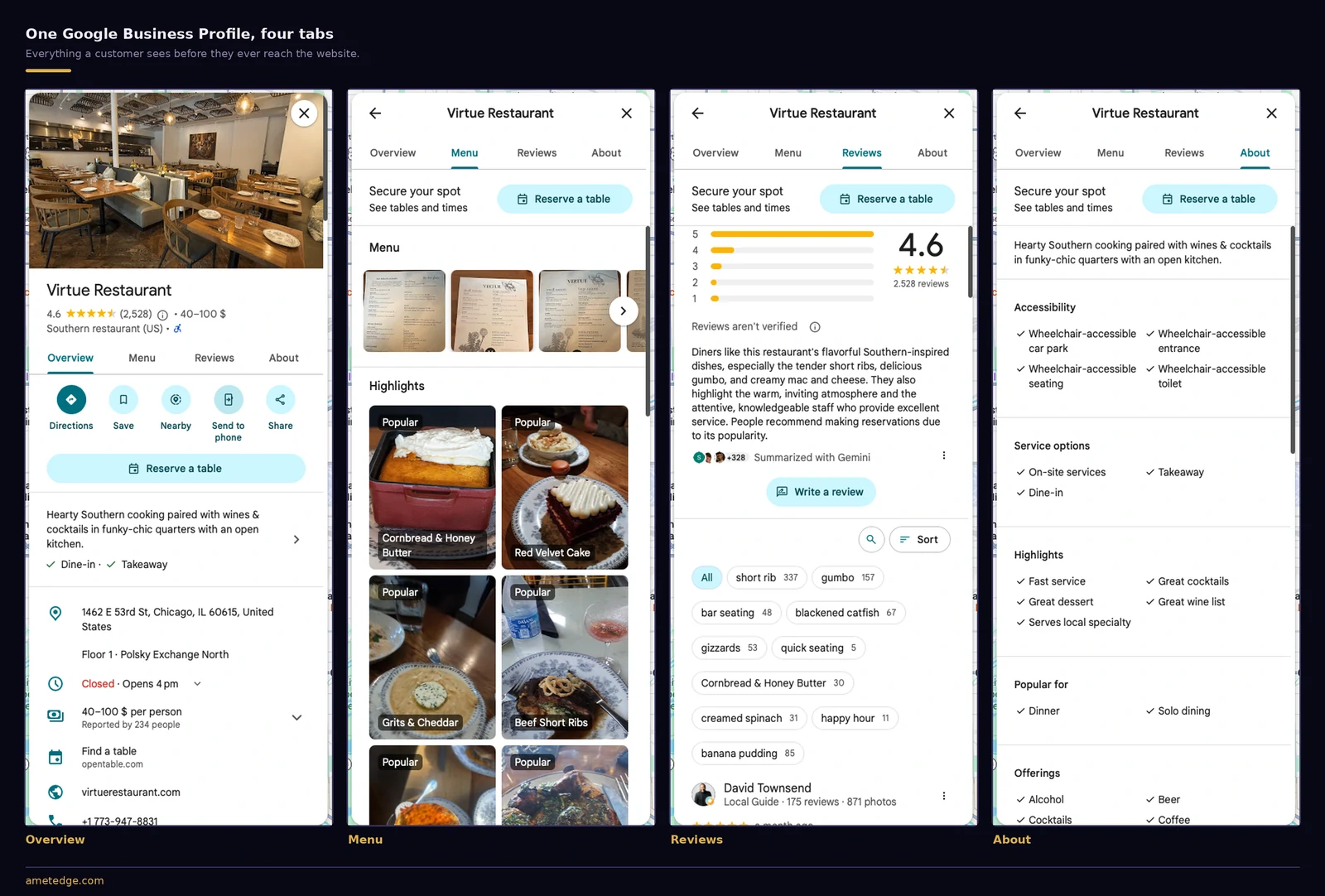
Four tabs instead of three, because there’s a menu. Photographs of the room and the food, taken deliberately rather than in passing. A one-line description of what the place is. Hours, address including which floor, phone, price range confirmed by 234 people. A reserve-a-table button inside the listing. Two and a half thousand reviews, with Google surfacing the dishes people name most often: short rib, gumbo, banana pudding. A full page of attributes covering accessibility, service options and what they serve.
Note what’s happening there. A customer can decide where to eat, see the menu, check the price, and book a table without ever visiting the restaurant’s website.
The twenty-minute setup
In order. Most of this is one sitting.
- Search for your business by name and see what’s already there. If you find a listing with “Claim this business” on it, that’s your starting point.
- Claim it. Google verifies you actually run the business, usually by phone, email, or video. Not instant, but not hard.
- Fix the address and hours first. These are the two things that send people to the wrong place at the wrong time. Include holiday hours; Google prompts you for them and almost nobody fills them in.
- Add your phone number and website.
- Choose your primary category carefully. It carries more weight than the rest of the categories combined. “Tire shop” and “auto repair shop” reach different searches.
- List your services, individually. This is the closest thing a profile has to pages, and an empty services list is a wasted section.
- Add your own photographs. Exterior so people recognise the building, interior, your team, your work. A Street View drive-by is not a photograph of your business.
- Write the description. A few sentences in plain language about what you do and who for.
- Fill in the attributes. Wheelchair access, payment methods, appointment policy. Dull, quick, and they appear in filtered searches.
- Then ask for reviews, and reply to them. All of them, including the bad ones, especially the bad ones. The volume matters more than the average.
The mistakes I saw in every unclaimed profile
- Never claimed at all. Two of the four profiles above. It’s free and it’s the whole foundation.
- No hours, or wrong hours. The most expensive small error on this list.
- The only photo is Street View. Your business is represented by a passing car’s camera.
- No services listed, so the profile can’t match specific searches.
- Reviews left unanswered for years. A reply costs a minute and is visible to everyone who reads afterwards.
- Chasing the rating instead of the count. The 5.0 came 102nd. The 4.9 came first.
So do you still need a website?
I’ve just shown you that the top result for a commercial search has no website. I sell websites. Let me answer this properly rather than talk around it.
The two things do different jobs.
Your profile answers “who’s nearby and are they open.” Where, when, how far, what the phone number is, whether other people liked it. That’s a fast decision made on a phone, often within a mile of your door.
Your website answers “what exactly do you do, what does it cost, and can I trust you.” That’s a slower decision, and it’s usually attached to a larger amount of money.
Sam’s Tire wins the first question completely and doesn’t compete for the second. Nothing about that profile can rank for “how much to mount four tires,” “used rims 18 inch price,” or “tire shop open Sunday Montgomery,” because there’s no page for any of it. Those are the searches of someone who has already decided to spend and is choosing between two shops.
Same for the AI assistants people increasingly ask. When I tested this on my own business, the assistant that could reach a page described it accurately, and the one that couldn’t described nothing. A business with no page gives them nothing to read.
There’s a third difference that only shows up when something goes wrong. The profile is Google’s property; the website is yours. Profiles get suspended, merged, edited by strangers, and occasionally hijacked, and the rules change without asking you. The distinction between what you own and what you rent applies here as directly as it does to your domain.
The honest version: if you can only do one thing this month, claim your profile, because it’s free and it’s twenty minutes. Then build the site, because the profile brings people to you and the site is what convinces them.
Why is my business not showing up on Google?
Usually because your profile isn’t claimed, isn’t complete, or is in the wrong category. Note that this is a different problem from your website not showing up, which is about indexing — that’s covered here. Search your business name: if there’s no panel with your hours and map pin, the profile is where to start.
How do I get on Google Maps?
If your business is physical, you’re probably already there in some form. Search for it, and if you find a listing, claim it rather than creating a second one. Duplicates are a nuisance to untangle later.
Is Google Business Profile really free?
Yes, entirely. There is no paid tier and no ranking you can buy. Anyone charging you for the listing itself is charging for work you can do yourself in twenty minutes.
Does a Google Business Profile replace a website?
No, though it can outrank one for map results, as the tire shop above shows. The profile handles “who’s nearby and open.” A website handles what you do, what it costs, and why someone should trust you.
What if my business has no physical address?
You can register as a service-area business and hide the address while still specifying where you work. If you’re not tied to a location at all — remote, online-only, no service area — a profile may not be available to you. Mine isn’t, which is why the examples in this article are other people’s businesses rather than my own.
How many reviews do I need?
More than you have, and consistently rather than in bursts. The comparison above is the clearest argument I can make: four reviews at 5.0 placed 102nd, 221 reviews at 4.9 placed first.
Written by Egor, founder and developer at AmetEdge. I build custom websites for small businesses across the US: restaurants and cafés, auto repair and body shops, contractors and home services, dental and medical clinics, salons and studios, gyms and trainers, and plenty of others. No agency, no upfront payment, and you own everything at the end.