How to Get Your Business Found by ChatGPT and AI Search
By Egor · · 10 min read
I asked two AI assistants the same four words about my own business: “who is AmetEdge.”
ChatGPT answered in detail. What I do, who I do it for, my pricing tiers with the actual numbers, my payment model, my policy on who owns the domain, even my background before this. Every claim cited my website.
Claude searched the web and came back with nothing. It suggested I might mean AMETEK, an industrial technology conglomerate, or AlefEdge, an edge-computing company, and pointed out that neither matched the spelling.
Same business. Same website. Same day.
Short answer: the fix isn’t on your website. It’s making your name exist somewhere other than your website. Here’s how I worked that out, and what actually moves the needle.

The test, and what it showed
Here are both answers, unedited. The first is what you hope for; the second is what most small businesses will actually get.
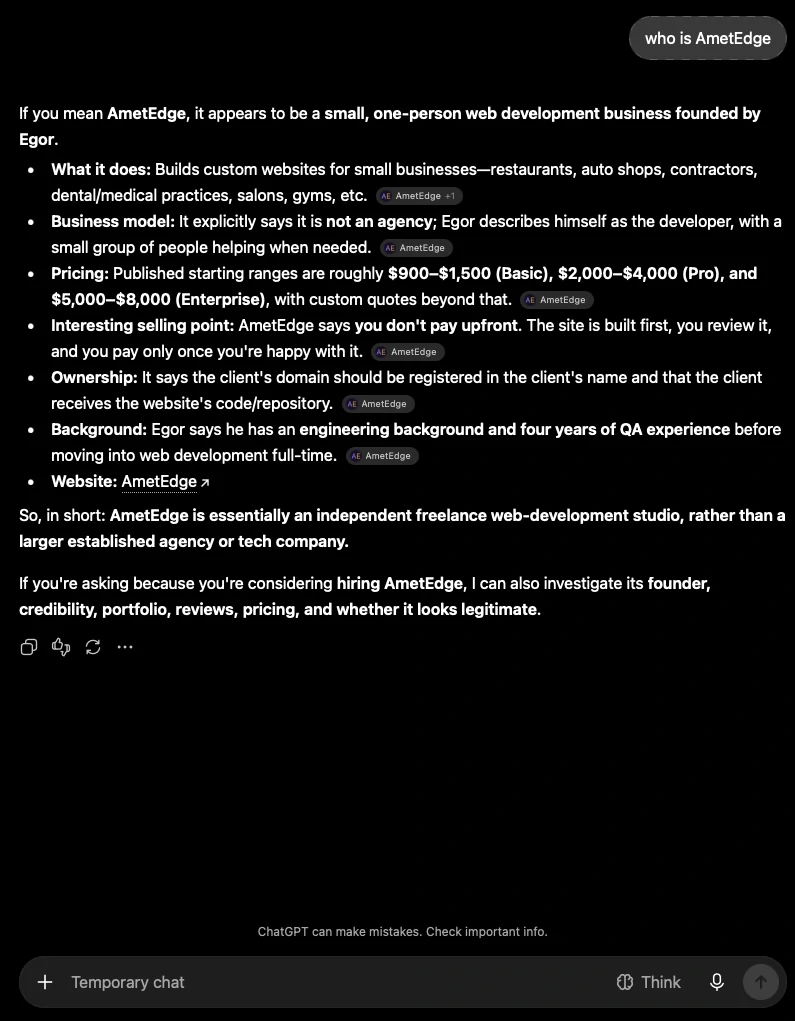
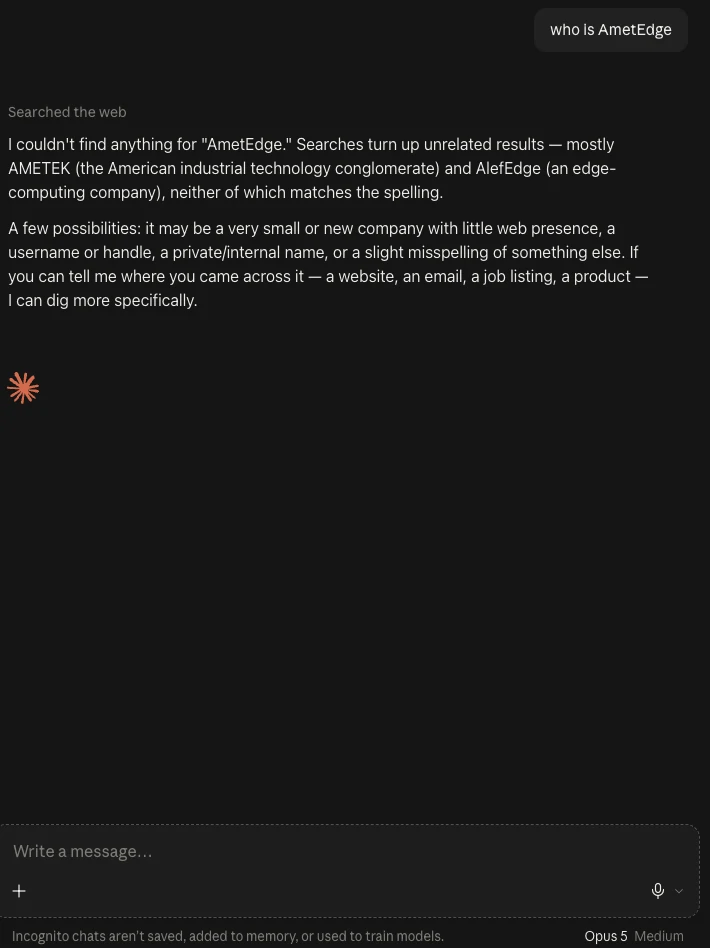
Then I ran a third test, and this is the one that turns the first two from an anecdote into something you can reason about.
Same assistant that had just told me my business didn’t exist. Same day, same site, same conversation. The only thing I changed was the input: instead of the name, I gave it the address. ametedge.com.
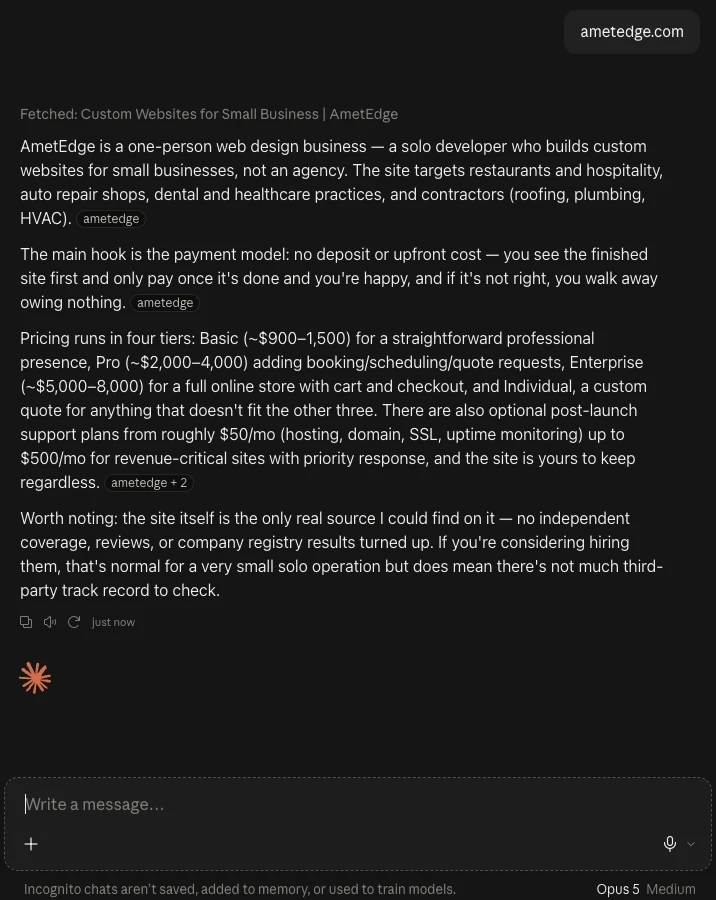
It fetched the page and got everything right. The one-person model, the payment structure, all four pricing tiers, the support plans, the fact that the site is yours to keep. Accurate in every particular, and better organised than some of my own copy.
That third test is the control, and it rules out most of what you’d otherwise blame. The site isn’t badly built, since the assistant read it fine. The content isn’t unclear, since it summarised it correctly. It isn’t blocked from crawlers, since the fetch worked. The assistant isn’t incapable of understanding a business like mine, since it understood this one in seconds.
Everything about the website was fine. What failed was the step before the website: connecting a name to an address.
ChatGPT’s search made that connection. Claude’s search didn’t, and once I supplied it manually, the difference vanished. That connection does not live on your website. It lives everywhere else.
The sentence that explains everything
When I gave Claude the domain, it added an observation I didn’t ask for:
The site itself was the only real source it could find. No independent coverage, no reviews, no company registry results. It noted that this is normal for a very small solo operation, but that it means there’s not much third-party track record to check.
That is the whole diagnosis in one paragraph, and it applies to most small businesses.
An assistant asked about a company does roughly what a careful person would do: it looks for the business across multiple sources and sees whether they agree. If the only source is the company’s own website, there’s nothing to cross-check, and if the name doesn’t appear anywhere the search index can find, there’s nothing to start from at all.
You cannot fix that on your own website. You fix it by existing somewhere else.
How to rank in AI search: what actually seems to work
Ordered by how much evidence there is, most to least. I’ll be explicit about which parts are established and which are still guesswork, because a lot of what’s published on this topic is confident about things nobody has demonstrated.
1. Be findable by name, somewhere other than your own site
This is the one my test actually demonstrated, and it’s the one most articles skip because it isn’t a technical setting you can toggle.
For a business that serves a specific area, the useful mentions are the ordinary ones: a Google Business Profile, listings in the directories your industry uses, a Yelp or industry-specific page, your chamber of commerce, a supplier or partner who lists you, a trade association. For anyone: a LinkedIn company page, and mentions on sites that aren’t yours.
None of this is new advice. It’s just that its importance went up when assistants started answering questions that people used to answer by clicking through five search results themselves.
2. Don’t accidentally block the assistants
This one is a genuine, common, silent failure, and it takes five minutes to check.
Each AI company runs several bots that do different jobs:
| Family | Examples | What it does |
|---|---|---|
| Training | GPTBot, ClaudeBot | Collects content to train models |
| Search index | OAI-SearchBot, Claude-SearchBot, PerplexityBot | Builds the index that answers are drawn from |
| User-initiated | ChatGPT-User, Claude-User | Fetches a page because someone asked about it right now |
Blocking one does not block the others, and this is where sites quietly disappear. A robots.txt copied from a 2023 template often blocks the training crawlers, which is a legitimate choice, while also blocking the search bots, which removes you from AI answers entirely. OpenAI states plainly that sites blocking OAI-SearchBot won’t appear in ChatGPT’s search answers.
Open yourbusiness.com/robots.txt and look. If you see Disallow: / under any of the search-index or user-initiated agents, that’s your answer.
For reference, here’s mine in full:
User-Agent: *
Allow: /
Disallow: /api/
Three lines. Everything open except an API path nobody should be reading anyway, and no AI bot named or blocked. You don’t need a long file. You need to not have blocked anything by accident.
For what it’s worth, my own logs from a single half-hour showed Claude-User and ChatGPT-User hits. I should be honest that those were almost certainly me, running the tests in this article. That’s the point of the user-initiated family: someone asks, the assistant fetches.
3. Traditional search still underpins most of it
Google’s own guidance says AI Overviews and AI Mode rely on the same signals as ordinary search rather than anything special. ChatGPT’s search draws on a web index. Assistants are not a separate channel with separate rules so much as a new interface on top of largely the same infrastructure.
Which means the unglamorous work still applies: be indexed, have a page for each thing you do, load quickly, and put the answer where a machine can find it. If you’re not sure you’re indexed at all, start here.
4. Answer questions directly, in plain sentences
Assistants quote what’s quotable. A page that states a price, a policy, or an answer in a clear sentence gives a machine something to lift. A page that says “contact us for pricing” gives it nothing.
I can see this in my own results: ChatGPT quoted my exact pricing ranges and my payment model because both are written plainly on the page. Neither is inferred. They were just stated, so they could be repeated.
5. Structured data, modestly
Schema markup describing your organisation, your services, and your location helps machines resolve who you are and connect the pieces. It’s cheap, it’s standard, and it’s part of ordinary technical setup rather than an AI tactic. Don’t expect it to do the heavy lifting.
About llms.txt
You’ll see this recommended constantly. It’s a file at your site root, written in plain Markdown, listing your key pages so a language model can find its way around.
I have one. I think you should probably ship one too. And I want to be straight about what the evidence currently shows, because most articles recommending it aren’t.
Google’s AI optimization guidance says explicitly that you don’t need special machine-readable files to appear in Search or its AI features, and Google representatives have said on the record that Search doesn’t use llms.txt. No major provider has publicly confirmed their production search or citation systems read it.
Then there’s the log data. Ahrefs analysed server logs across 137,210 domains for May 2026 and found that 97% of llms.txt files received zero requests — not from an AI bot, not from a human, not from a script (checked August 2026). Of the small share that were fetched at all, a meaningful chunk came from SEO audit tools checking whether the file exists, which is the industry studying itself.
The most damning detail isn’t the percentage, though. It’s that AI bots never requested llms.txt on domains where the file didn’t exist. They aren’t probing for it. A crawler that wanted the file would ask and collect 404s; these don’t ask. Separately, SE Ranking analysed roughly 300,000 domains and found no correlation between having the file and how often a domain gets cited in AI answers (checked August 2026). The sharpest line in their write-up: when they removed llms.txt as a variable from their prediction model, the model got more accurate. The file was adding noise, not signal.
The honest verdict: for a small business website in 2026, llms.txt is close to zero cost and close to zero measurable benefit. The genuine use case today is developer documentation, where coding assistants fetch pages on demand and Anthropic and OpenAI both recommend the format for that purpose.
So: write one if it takes you an hour. Don’t write one instead of the four things above it on this list.
How to test your own business
Ten minutes, and you’ll know more than any tool will tell you.
- Ask three assistants “who is [your business name]” — ChatGPT, Claude, and Perplexity at minimum. Use a fresh or temporary chat so previous conversations don’t colour the answer.
- Note whether they find you at all. Not whether the answer is flattering. Whether the name resolves to your business.
- Then give them your domain directly and ask the same thing. If the second answer is good and the first was empty, your website is fine and your problem is that nothing connects your name to it.
- Ask “is [your business] legitimate” or “should I hire [your business].” This is what a real prospect asks, and the answer will tell you what a machine can and can’t verify about you.
- Open your
robots.txtand check the three bot families. - Repeat in three months. This whole area is moving fast enough that a single snapshot means little.
What I’d be sceptical about
A whole consulting category has appeared around this, with acronyms like AEO and GEO, and much of it is selling certainty that doesn’t exist yet.
Be wary of anyone who promises a specific position in AI answers, since there’s no ranking to occupy in the sense there is on a search results page. Be wary of tactics justified by “the algorithm,” because none of these systems have published one. And be wary of anything that requires rewriting your site into a format only machines enjoy reading, since assistants are drawing on the same web everyone else uses.
The one thing I’d say with confidence, because I watched it happen on my own business: if nothing on the internet other than your own website mentions your name, an assistant asked about you may find nothing at all. Fixing that is not a technical problem.
How do I get my business to show up in ChatGPT?
Make sure the assistants can reach your site, then make sure your business name appears somewhere other than your own website: a Google Business Profile, industry directories, a LinkedIn page. The technical part is quick. The mentions are the work.
Does llms.txt help?
Not measurably, on current evidence, for a normal business site. Google says it isn’t needed for its AI features, no major provider confirms using it in production, and the large majority of published llms.txt files are never requested. It costs almost nothing to add, so it’s not a bad idea. It’s just not the lever people claim.
Is AI search optimization worth it for a small business?
Parts of it are, and they’re the parts that overlap with things you should be doing anyway: being indexed, being mentioned somewhere other than your own site, answering questions in plain sentences, not blocking crawlers. What isn’t worth it yet is paying someone for AI-specific tactics built on mechanisms none of these companies have published.
Will AI search replace Google?
The behaviour is shifting rather than switching. What matters practically is that both channels currently draw on similar signals, so the work that makes you findable in one tends to help in the other. Optimising separately for “AI search” is mostly premature.
Should I block AI crawlers?
That’s a real decision with a real trade-off. You can block the training crawlers while allowing the search and user-initiated ones, which keeps you in AI answers without contributing to model training. What you shouldn’t do is block them all by accident, which is what a stale robots.txt does.
My competitor shows up in ChatGPT and I don’t. Why?
Usually because they’re mentioned somewhere you aren’t: a directory, a review site, a news mention, a partner listing, an active Google Business Profile. Check what sources come up when you search their name in a normal search engine, and you’ll typically find the answer there.
Written by Egor, founder and developer at AmetEdge. I build custom websites for small businesses across the US: restaurants and cafés, auto repair and body shops, contractors and home services, dental and medical clinics, salons and studios, gyms and trainers, and plenty of others. No agency, no upfront payment, and you own everything at the end.